Technology Audit
Automotive Appraisal and Training Department
Manager
Łukasz Dębski
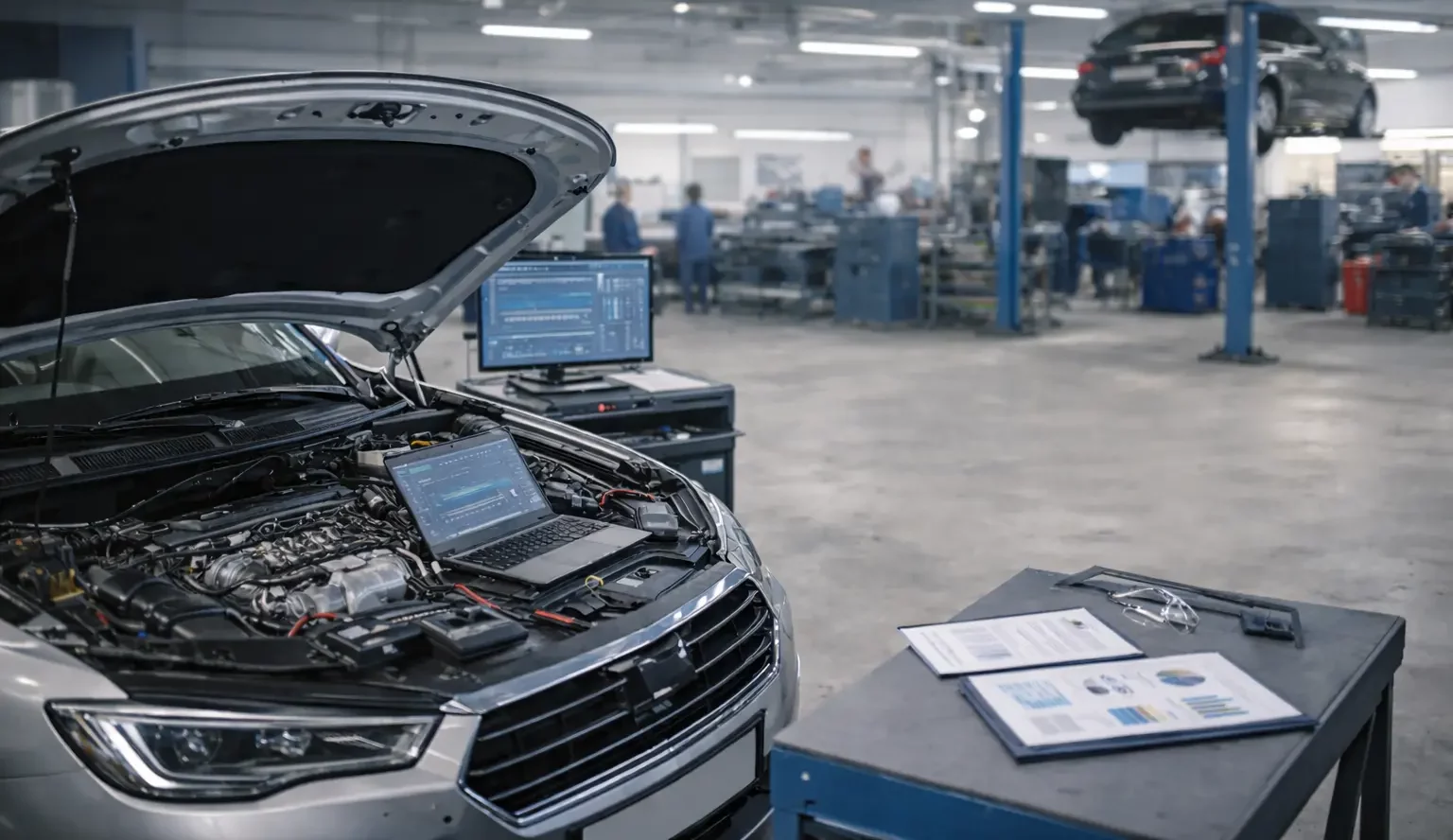
An audit is a tool that supports a company’s growth. Its purpose is to provide a detailed assessment of your company’s current state, and it may focus on a product, process, project, problem, program, or organizational unit within the company.
We offer comprehensive audits that help identify growth potential, optimize processes, and increase companies’ competitiveness.
We identify a company’s strengths and weaknesses in the following areas:
- technology, as well as manufacturing and service processes,
- technical condition, vehicle fleet operation and management system,
- technical resources, infrastructure,
- fuel and energy management for transportation vehicles,
- research and development potential,
In addition, we handle matters related to:
- innovation,
- intangible and legal assets,
- quality management system,
- human resources,
- intellectual property law,
- knowledge management.
The audit is conducted by technical experts in specific subject areas, tailored to your needs. The experts systematically identify the company’s strengths, weaknesses, opportunities, and threats based on data collected from various areas of your business.
We conduct audits in the following areas, among others:
- technologies used,
- production processes,
- technical resources,
- intangible assets (e.g., type approval documentation, certificates and approvals held),
- intellectual property rights,
- quality management systems that have been implemented,
- supply and warehousing systems,
- operations and technical maintenance systems, service,
- assessments of the energy and environmental situation,
- traffic organization and safety within and around the company.
The audit results in a report that outlines the company’s current technological status and presents specific proposals for improving the company’s operations.
We guarantee confidentiality, impartiality, and independence in carrying out the task entrusted to us.
The reasons for conducting a technology audit include, among others:
- problems are arising within the company that are negatively affecting production
or sales, - There is an expectation that the company’s competitiveness will improve or its market position will strengthen, and that the efficiency and consistency of production quality, as well as the company’s revenue, will increase,
- There are plans to expand in a specific area of business, and there is a need to assess the project’s profitability and feasibility,
- seeking funding opportunities for development
and/or investment activities, through loans or participation in innovation competitions
, - plans to submit a project proposal that will result in the creation of a new
or a significantly improved product or process, - plans to purchase or consolidate – an analysis of the risk of a potential loss of production continuity due to supply chain disruptions or errors in manufacturing processes,
- In companies planning or carrying out production, development work, or scientific research for the sake of national security and defense, it is necessary to:
- technical and economic analysis and feasibility study,
- analysis of documents enabling the initiation of procedures related to
the procurement of products by the Ministry of National Defense, - assessments of a product’s technology readiness level,
- analyses regarding the safeguarding of technical strategic reserves.
General Scope of the Łukasiewicz–PIMOT Technology Audit in the Automotive Sector
1 | Technical Resources, Intellectual Property, and Intangible Assets |
1.1 | Verification of the list of structural groups submitted for evaluation |
1.2 | Verification of 3D models submitted for evaluation |
1.3 | Assessment of the completeness of the submitted bill of materials (BOM) |
1.4 | Subcontractor Evaluation (Completeness, List, Collaboration Criteria) |
1.5 | Review of Design Documentation |
1.6 | Evaluation of Technical Documentation |
1.7 | Review of other documentation (operational, maintenance, etc.) |
1.8 | Evaluation of the list of production equipment |
1.9 | Assessment of resources for the purpose of identifying tools and equipment |
1.10 | Assessment of Intellectual Property and Intangible Assets (WNiP) |
1.11 | Evaluation of Ongoing Research and Development Projects Funded by External Sources |
1.12 | Review of Low- and High-Voltage Electrical Installation Documentation |
2 | Manufacturing Processes and Storage of Manufacturing Documentation |
2.1 | Assessment of Production Process Oversight |
2.2 | Assessment of the Storage and Transportation of Finished Products |
2.3 | Assessment under the Supplier Evaluation System |
2.4 | Assessment of Warehouse Operations and Supplier Control |
2.5 | Assessment of the Identification of Supplies and Finished Products |
2.6 | Evaluation of the Product Complaint Procedure |
2.7 | Assessment of the method, scope, and number of audits and internal controls |
2.8 | Assessment of Access and Oversight of Testing and Inspection Equipment |
2.9 | Assessment of internal audits and inspections (documentation, analysis, and dissemination of results) |
2.10 | Assessment of the condition of production facilities (halls) and their equipment to ensure appropriate conditions for the production process |
2.11 | Assessment of nonconformities identified as a result of internal audits and inspections (implementation, correction) |
2.12 | Assessment of Defective Product Management and Analysis of Waste Management |
3 | Quality Management System Documentation |
3.1 | Review of Documentation Verifying the Company’s Operations |
3.2 | Assessment of a company’s management system(s) in the context of customer needs |
3.3 | Evaluation of the documentation implemented to ensure production (e.g., prepared for the purpose of obtaining type approval) |
3.4 | Assessment of the company’s organizational structures (structure, communication, responsibilities) |
3.5 | Assessment of the implementation of requirements governing processes and evidence (records of those processes) |
4 | Type Approval Documentation |
4.1 | Analysis of the completeness and assessment of the formal and legal status of the documentation required for the type approval or vehicle registration procedure |
4.2 | Assessment of the status of type-approval documentation in light of a change in manufacturer and/or assembly plant, and management of such documentation |
4.3 | Assessment of the possibility of extending the type approval certificate in light of proposed changes to the vehicle’s design or configuration |
5 | Service and Shopping |
5.1 | Analysis of the service network, broken down by closed- and open-type stations |
5.2 | Analysis of the Equipment Status at Service Stations |
5.3 | Analysis of warranty agreements with suppliers to assess the possibility of shifting warranty costs |
5.4 | Analysis of Waste Management |
5.5 | Analysis of the purchasing process: individual orders, framework agreements, and purchase forecasts |
5.6 | Analysis of the Supplier Selection Process |
5.7 | Analysis of the Supply Control System |
5.8 | Analysis of the Parts Distribution System at the Company |
5.9 | Analysis of warehouse facilities to ensure proper storage conditions |
5.10 | Analysis of the Product Complaint Process |
6 | Energy and the Environment |
6.1 | Assessment of the Company’s Fuel Management |
6.2 | Assessment of the Share of Renewable Energy Sources (RES) in a Company’s Energy Mix |
6.3 | Life Cycle Assessment (LCA) |
6.4 | Carbon Footprint Analysis |
We also offer audits in other areas, to be agreed upon on a case-by-case basis, as well as audits of other areas of your business through the Łukasiewicz Research Network: